

02
Our strategy focuses on expanding and diversifying our business portfolio, strengthening profitability and creating long-term value for shareholders.
Our Strategy
HELLENiQ ENERGY’s strategic plan VISION 2025 has successfully delivered on its objectives, validating our initial strategic choices for a balanced transition: future-proofing and optimizing our refinery operations through decarbonization, expanding our international presence in the downstream business, and establishing a vertically integrated Power business (RES, electricity and natural gas) as a second growth pillar, while evolving our governance and operating model.
This strong execution is even more critical in the current environment. Market volatility remains elevated and the energy transition is facing headwinds, while the outlook across our core markets continues to be favorable.
Key Market Trends
In an environment of increased volatility and challenges in the energy transition, key markets remain favorable. Global growth and energy transition are evolving unevenly, reinforcing the importance of energy security. Demand for liquid fuels and natural gas, especially in the Mediterranean, remains strong, while renewables and electromobility are growing, increasing the importance of flexible energy generation and storage.
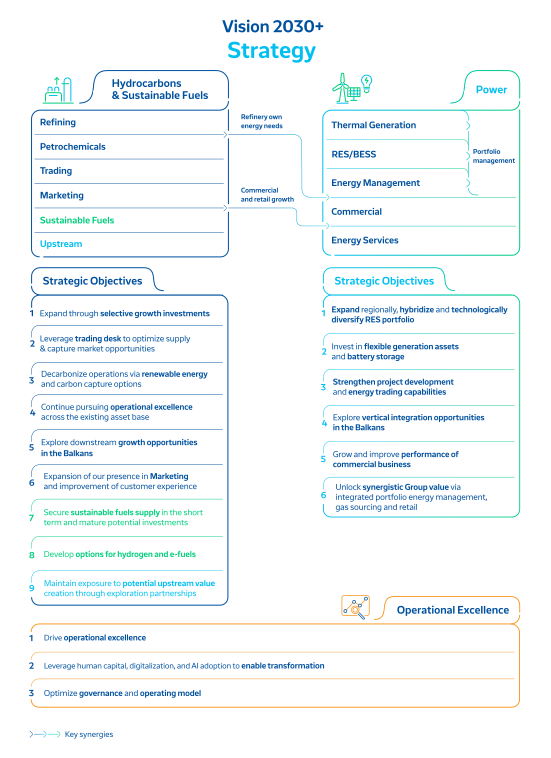
Our strategic compass for the next phase of growth is VISION 2030+, which is designed to navigate a rapidly evolving energy landscape, drive growth through diversification, and deliver sustained value to shareholders. VISION 2030+ focuses on the continuous improvement of competitiveness in Downstream activities, expanding the presence in international markets, as well as the transformation of the Power (RES, electricity and natural gas) business into an autonomous, vertically integrated platform, while leveraging synergies at the Group level.
VISION 2030+ focuses on further developing and growing our two key pillars: Hydrocarbons & Sustainable Fuels and Power (RES, Electricity, Natural Gas).
1. In the Hydrocarbons & Sustainable Fuels business, our key strategic initiatives include:
- pursue selective growth investments,
- leverage the trading platform to optimize supply and capture market opportunities,
- decarbonize operations to reduce refineries’ energy consumption by meeting operational electricity needs through renewable energy sources utilization and carbon capture solutions implementation,
- maintain operational excellence across the existing asset base,
- explore Downstream growth opportunities in Southeast Europe,
- strengthen the Marketing footprint and expand the value proposition (premium fuels, EVs, non-fuel retail),
- invest selectively in sustainable fuels to secure post-2030 positioning and develop options in hydrogen and e-fuels, while,
- maintain exposure to potential upstream value creation through exploration partnerships.
2. In the Power business, our key strategic initiatives include:
- regionally expand, hybridize and technologically diversify the renewables portfolio,
- invest in flexible generation assets and battery storage,
- grow and improve performance of commercial business,
- further build-up project development and energy trading capabilities, all while,
- maximize energy management synergies from our integrated generation portfolio.
Operating model & governance
Horizontal initiatives support the delivery of strategic objectives across the Group. These include accelerating digital transformation and AI adoption, reinforcing operational and cost excellence, leveraging human capital, while continuing adjustments towards fit-for-purpose governance and operating model.
Our ambition is to achieve a 30% reduction in our GHG footprint by 2030, complemented by an additional 20% emissions avoidance through the expansion of the RES portfolio. We will continue to closely monitor regulatory developments related to CCS, with a long-term commitment to achieving net-zero emissions by 2050.
Main Objectives per Business Area

Refining, Supply & Trading and Petrochemicals
In the area of refining supply, trading and petrochemicals, our key priorities encompass ensuring safety, decarbonizing processes, enhancing energy efficiency and autonomy, digital transformation, expanding petrochemicals’
production capacity, leverage of our trading capabilities in the new Geneva desk, investing in cleaner fuels alongside continues operational excellence.
Key strategic initiatives include:
- Strengthening safety through training, standards, and enhanced procedures.
- Advancing digital transformation across the supply chain, predictive maintenance, and process safety systems.
- Supplying system crude and feedstocks, trading system products and expanding the trading business through Geneva-based HELLENiQ Petroleum Trading.
- Implementing energy efficiency and autonomy projects across all refineries.
- Evaluating a new 250 ktpa Alkylate unit at the Aspropyrgos refinery (AIC), with the aim of reaching a final investment decision in early 2027.
- Developing a standalone 150 ktpa SAF production unit.
- Developing the “Green Hub North” project (PV/BESS and direct high-voltage connection to the Thessaloniki refinery – TIC) and “Green Hub South” project (direct PV/Wind/BESS connections to EIC/AIC).
- Advancing CCS through conversion of the SMR unit at the Elefsina refinery (EIC).
- Exploring hydrogen, recycling, and synthetic fuel opportunities, including:
- e-methanol and e-jet fuels using captured CO2 and green hydrogen.
- e-ammonia utilizing excess electricity from Green Hub North and green hydrogen.
- Upgrading and expanding polypropylene production units, resulting in a capacity increase to 300 ktpa from 240 ktpa.

Marketing
Domestic Marketing
The main initiatives of the program include:
- Network rationalization and expansion.
- Increasing the market share of COMO* service stations and premium products.
- Expanding the range of products and services (non-fuel retail (NFR), EV charging services, loyalty programs).
- Implementing a “net-zero energy” solutions at COMO* stations.
- Developing tailored commercial strategies for industrial clients.
*COMO – Company Owned, Managed & Operated.
International Business
The objective is to strengthen our footprint in the Southeast European markets focusing on sustainable growth and operational excellence.
Key priorities include:
- Maintaining a leading position and growing market share in Cyprus, Montenegro and the Republic of North Macedonia.
- Expanding in Bulgaria and Serbia through targeted network growth and supply chain optimization.
- Enhancing the range of products and services, including loyalty programs and EV charging.
- Installing photovoltaic systems across our petrol station network to achieve net zero targets.
- Improving OKTA profitability and leveraging the reactivation of the VARDAX pipeline to reduce transportation costs and explore potential trading opportunities in the region.
- Exploring cross-border electricity trading opportunities, particularly in Cyprus and the Republic of North Macedonia.
- Assessing market entry into new regional markets.
- Advancing retail digitalization to enhance customer experience and optimize operating costs.
Power
(RES, Electricity, Natural Gas)
Renewable Energy Sources (RES)
The Group aims to secure a leading regional position in the renewables market through:
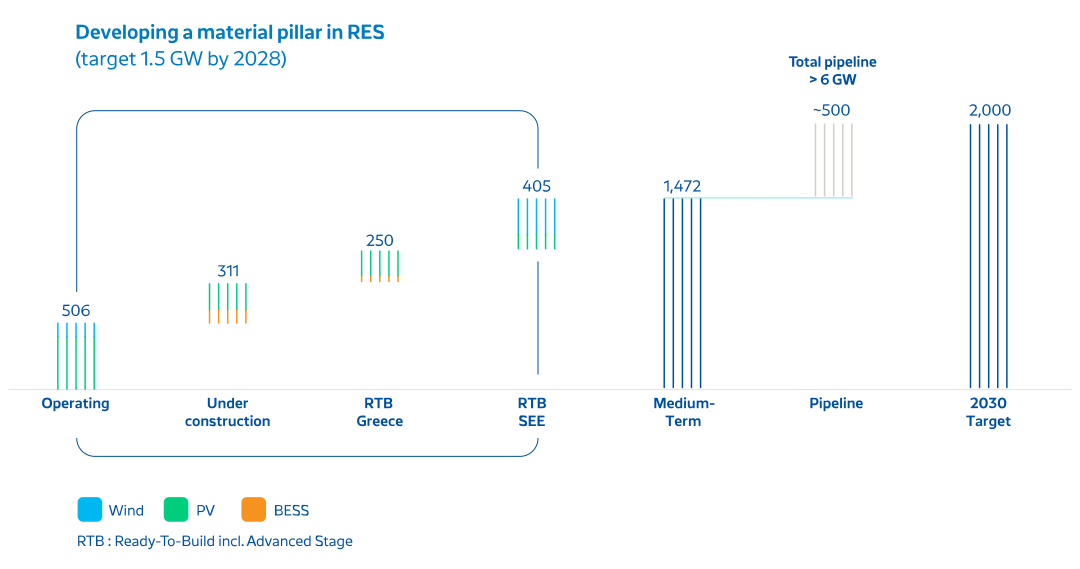
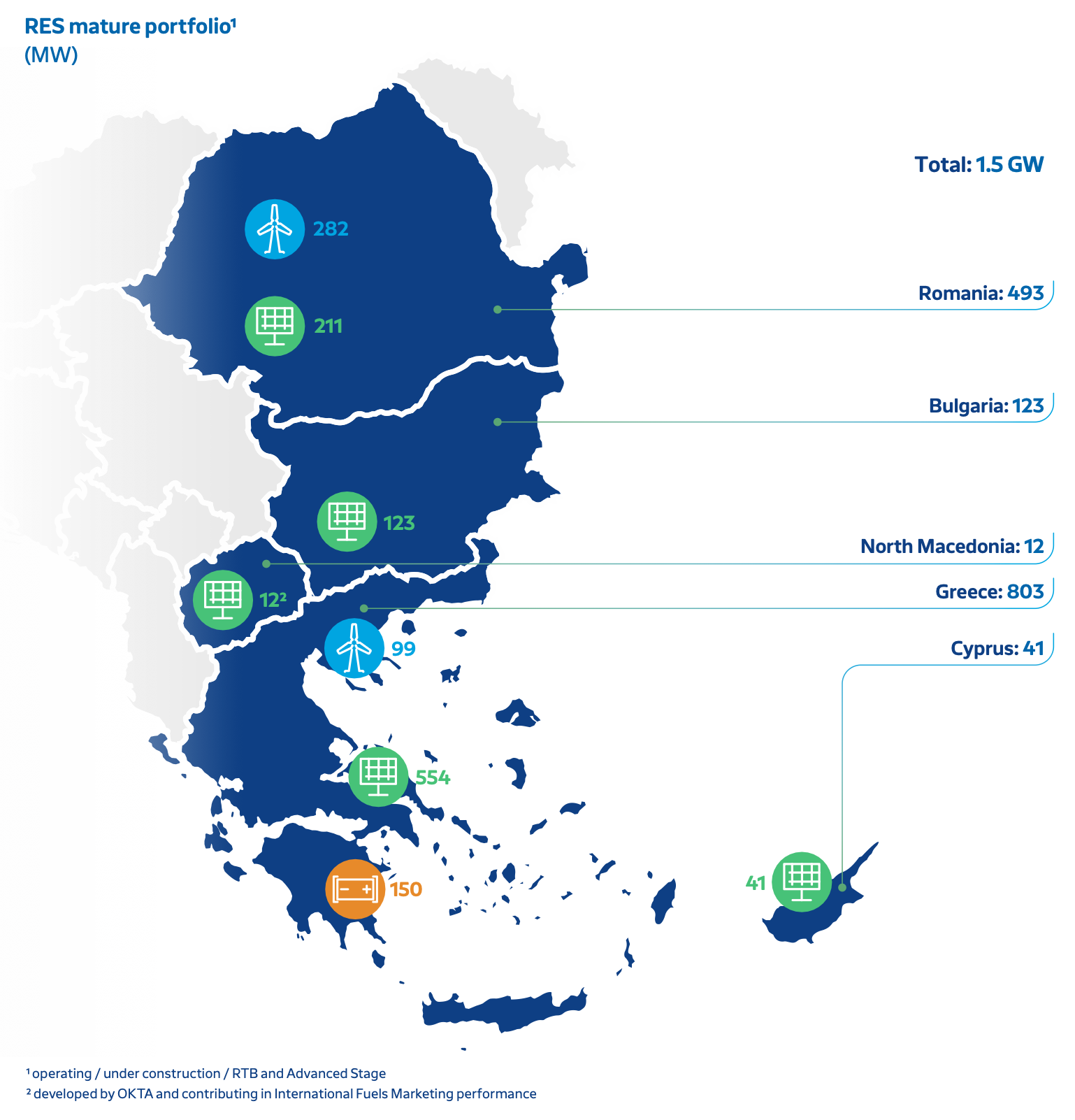
- Developing a 1.5 GW portfolio of operational capacity by 2028, and 2 GW by 2030 across PV, wind and battery storage projects.
- Commercializing renewable assets and exploring vertical integration in Southeast Europe.
- Advancing offshore wind development.
The Group has established a strong position in Greece and selected international markets, with a development pipeline of approximately 6 GW in Greece, Cyprus, Romania and Bulgaria. Operating capacity reached 506 MW in 2025, with an additional 1 GW of projects under construction or
in advanced development stages.

Enerwave
HELLENiQ ENERGY aims to build a best-in-class power business, leveraging synergies across refining, marketing, renewable energy and e-mobility businesses.
Aligned with this strategy, the Group completed the acquisition of the former ELPEDISON and introduced its new corporate identity, Enerwave, marking a major milestone in its transformation.
Strategic priorities include:
- Growing and improving commercial business performance.
- Integrating generation assets, including refinery demand response, to enhance margins.
- Completing the upgrade of the Thisvi plant by 2027.
- Optimizing gas sourcing through captive demand.
- Strengthening energy trading capabilities.
- Driving operational excellence.
- Enhancing energy management in coordination with the RES portfolio.

Exploration & Production
The key initiatives include:
- Performing seismic acquisitions in four newly awarded offshore blocks with Chevron.
- Finalizing the exploration drilling decision for “Block 2” with Exxon Mobil.
-
Reaching drill-or-drop decisions for “Southwest Crete” and “Block 10”.
E-mobility
The Group continues to expand its presence in the EV charging market in Greece and internationally. Growth initiatives focus on enhancing customer e-mobility solutions, expanding the DC fast-charging infrastructure at fuel stations and key locations, and developing AC charging networks across public, semi public, and private sites.
Digital Transformation
HELLENiQ ENERGY’s Digital Transformation Program, an essential component of the Group’s strategy, is progressing successfully, by upgrading the way our people work, supporting performance improvement initiatives and expanding its footprint in new areas of business activity.
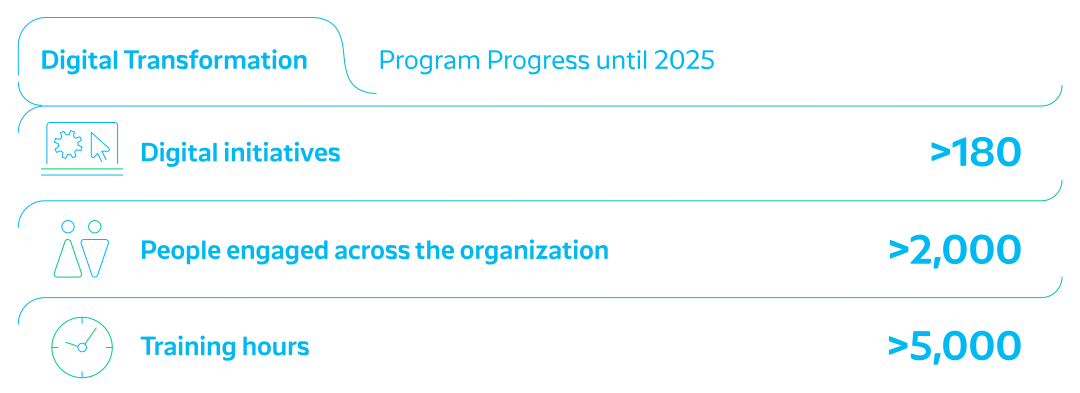
So far, more than 180 digital initiatives have been initiated or completed across the organization, involving over 2,000 individuals in various working groups and utilizing more than 5,000 hours of specialized training.
Additionally, it brings substantial benefits in safety and risk management efficiency, helps reduce the environmental footprint, and promotes a culture of innovation.
So far, more than 180 digital initiatives have been initiated or completed across the organization, involving over 2,000 individuals in various working groups.
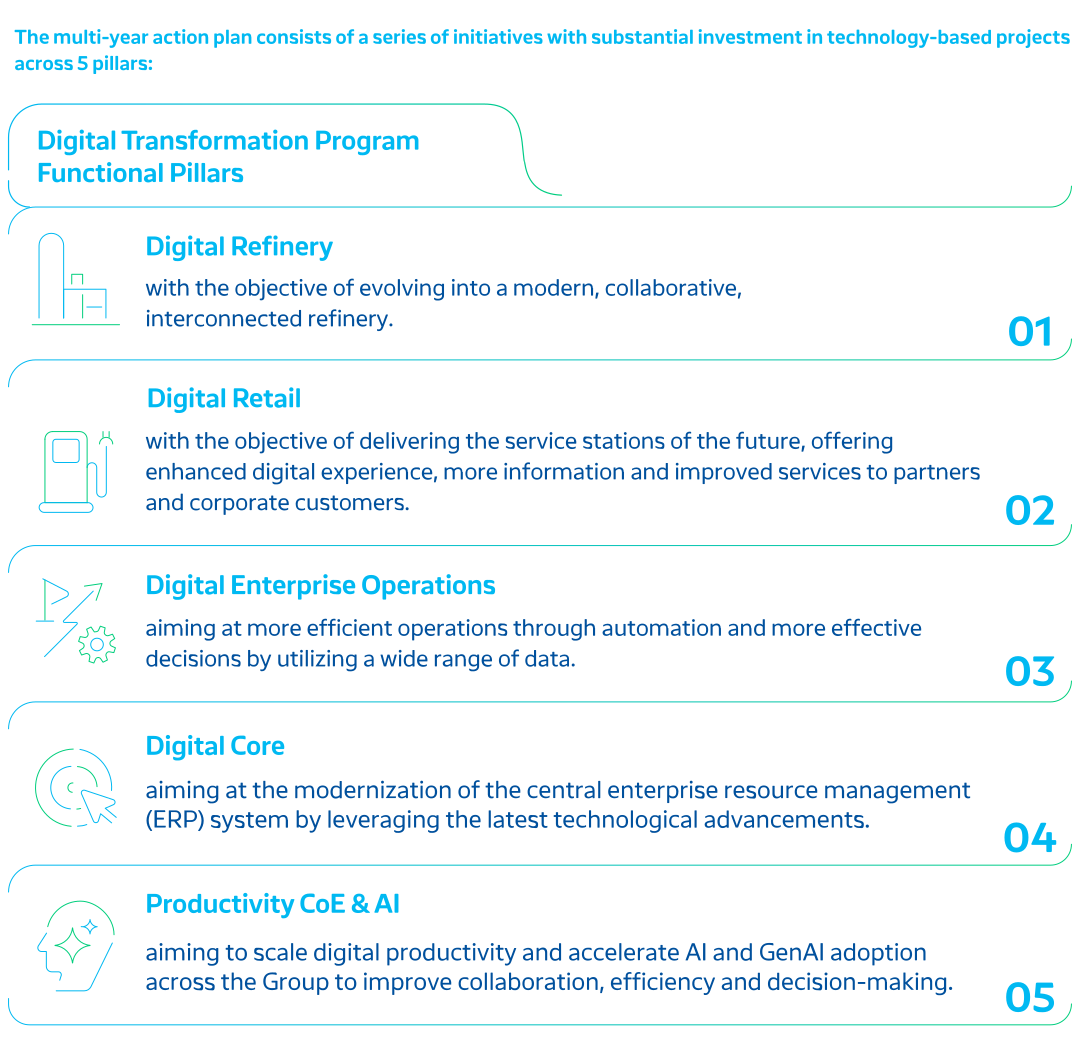
The digital transformation program made significant progress in 2025, delivering tangible financial benefits and operational improvements.
Key initiatives include strengthening Asset Management with predictive maintenance and root cause analysis tools, leveraging AI to optimize the FCC unit, and providing digital support for critical maintenance activities.
In parallel, solutions were implemented to automate processes (such as claims and safety management), along with the development of a digital assistant for refineries and the optimization of the supply chain.
At the organizational level, key advancements included the upgrade of core systems (SAP S/4HANA), the development of a modern data ecosystem (Project Phoenix) enabling real-time analytics and AI‑driven insights, as well as the modernization of approval, expense and procurement processes. In parallel, the use of Generative AI tools was expanded, digital access to corporate policies was enhanced, HR systems were further integrated, and an AI governance framework was implemented in alignment with the EU AI Act.
In the Fuels Marketing business, new solutions were deployed to enhance customer experience and operational efficiency, including the new EKO application (One-Card), the digitalization of tax processes, the upgrade of retail station operations, and a unified real-time aviation refueling platform.
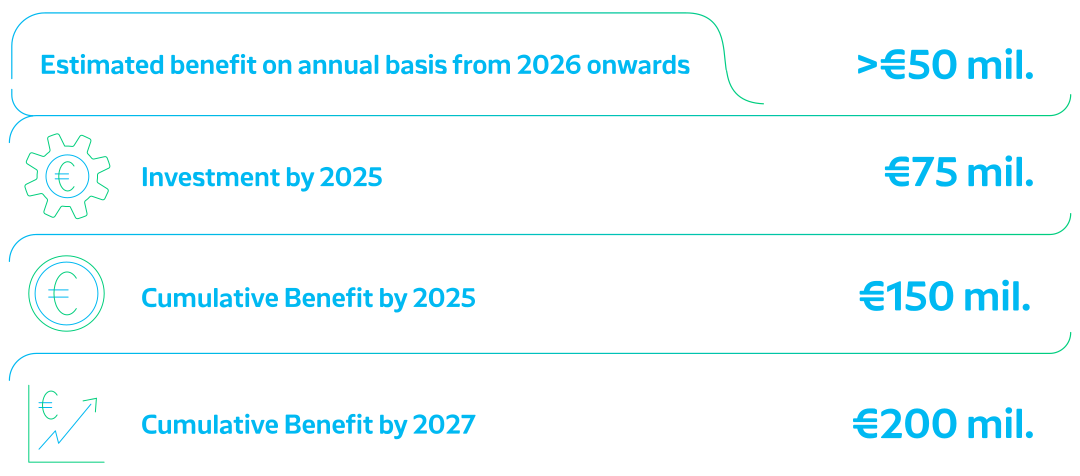
The Digital Transformation program was launched six years ago, with a cumulative investment amounting to €75 million, and has yielded substantial financial returns. Cumulative benefits have already exceeded €150 million and are expected to reach €200 million by the end of 2027. Additionally, the estimated annual benefit has already reached €50 million, is expected to exceed this level from 2025 onwards, and is projected to reach €70 million by the end of 2028.
For 2026, several new initiatives have already been planned, with expanded use of AI technologies, aiming to accelerate the Group’s transformation, enhance safety and competitiveness, simplify operations, and improve both employee and customer experience.
Indicatively, the following are expected in 2026:
- Development of tools for safety management and digital work permits.
- Establishment of a Unified Operations Center for real-time monitoring and performance management.
- Strengthening trading activities with end-to-end lifecycle support.
- Completion of SAP S/4HANA implementation for commercial entities.
- Improved fuel stations operations, including ordering and maintenance processes.
- HR digital transformation with AI integration and HRMS expansion.
- Enhancement of Data & AI capabilities and deployment of advanced analytics and GenAI solutions.
- Adoption of agentic AI technologies to boost automation and efficiency.
- Implementation of a modern Identity Management system and strengthened cybersecurity in line with NIS2.
Overall, these initiatives aim to create smarter, more integrated, and more efficient operations across the Group.
02
Our Strategy